Introduction
Pharmaceutical manufacturers are moving away from bottles and blister cards toward stick packs. This shift is driven by patient-centric dosing needs, tighter margins, and compliance auditors who expect proof of consistency on every line.
Stick packs get discussed constantly at trade shows, but the real payoff shows up somewhere less glamorous: fill-weight logs and changeover schedules on the plant floor.
This article breaks down five practical benefits stick packs deliver for pharma manufacturers, backed by what actually happens in production, not just what looks good in a sales deck.
Key Takeaways
- Automated fill systems tighten dosing accuracy, reducing manual measuring reliance
- Tear-open formats support adherence for pediatric, geriatric, and multi-drug patients
- Compact laminates cut film use versus wider sachets or rigid bottles
- High-speed VFFS lines process hundreds to 1,000+ sticks per minute
- Multi-layer barriers protect powders, liquids, and modified-release drugs from moisture and light
What Is a Stick Pack (Brief Context)
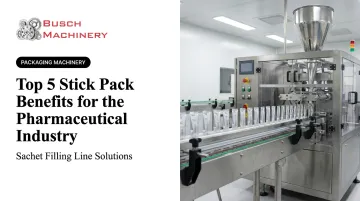
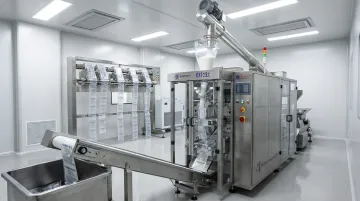
A stick pack is a narrow, flexible pouch sealed on two or more sides, built to deliver a single controlled dose. It's produced on vertical form-fill-seal (VFFS) equipment, the same type of systems that Busch Machinery supplies to pharmaceutical manufacturers. The equipment forms a roll of laminate film into lanes, then fills, seals, and cuts it in one continuous motion.
In pharma, you'll find stick packs holding:
- Oral powders and granules
- Multi-particulates and mini-tablets
- Liquid dosage forms for pediatric and geriatric patients
- General-population oral medications requiring precise, portable dosing
The stick pack format matters because of what it delivers: precise dosing and a better patient experience for patients across age groups.
Top 5 Stick Pack Benefits for the Pharmaceutical Industry
The five benefits below focus on outcomes pharma manufacturers track daily: dosing accuracy, compliance, cost, sustainability, and formulation flexibility. Each one ties directly to a KPI someone on your quality or production team is already measuring.
Benefit 1: Precise Dosing and Quality Control
Stick packs remove the scoop-and-spoon guesswork. Instead, auger fillers, slider dosing systems, or optical tablet counters deliver an exact unit dose on every single cycle.
This matters because dosage uniformity isn't optional. USP <905> governs how manufacturers demonstrate content uniformity or weight variation, and for most formulated powders and granules, that means passing content uniformity testing with an acceptance value of 15.0 or less across sample sets.
Machine-level dosing precision directly feeds this compliance data.
KPIs impacted:
- Fill-weight variance
- Batch rejection rate
- Compliance audit outcomes
This benefit carries the most weight for narrow therapeutic index drugs, controlled substances, and weight-based pediatric dosing, where a small fill error has outsized consequences.
Pairing a stick pack line with precision weighing and checkweighing equipment, an area Busch Machinery works in regularly, adds another layer of control by catching fill-weight drift before it becomes a batch problem.
Benefit 2: Improved Patient Compliance and Ease of Use
A slim, tear-open pack is easier to open and swallow than a bottle cap or a foil-backed blister card. That matters more than it sounds, especially for pediatric patients, seniors with arthritis, and anyone with dysphagia who struggles with tablets or capsules.
Medication non-adherence is a bigger problem than most people realize. The CDC reports that roughly 1 in 5 new prescriptions is never filled, and about half of filled prescriptions are taken incorrectly, whether that's wrong timing, wrong dose, or wrong duration.
Packaging format genuinely moves the needle here. A meta-analysis covering 52 studies and nearly 23,000 participants found that packaging interventions raised average adherence from 63% to 71% compared to standard formats.
That research focused on blister packs and pill organizers, not stick packs specifically. The underlying mechanism, removing friction from the dosing routine, applies directly to stick pack design.
KPIs impacted:
- Adherence rate
- Caregiver error rate
- Patient satisfaction scores
This benefit matters most for chronic therapies, multi-dose daily regimens, and take-anywhere medications that don't need water.
Benefit 3: Reduced Material Waste and Sustainability
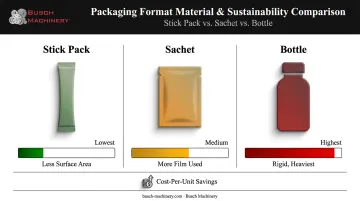
A stick pack's narrow, form-fitted shape simply uses less film than a wider sachet or a rigid bottle designed to hold the same dose. Less surface area means less laminate per unit.
That reduction shows up in two places: your packaging cost per unit and your waste footprint. For manufacturers under ESG reporting pressure or managing high-volume SKUs, even modest material savings compound fast across millions of units per year.
KPIs impacted:
- Material cost per unit
- Packaging waste volume
- Shipping density
One caveat worth flagging: less material doesn't automatically mean easier recycling. Multi-layer laminates combining PET, aluminum, and polyethylene are hard to separate at end of life, so procurement teams should weigh material savings against actual recovery pathways, not just grams saved.
Benefit 4: Cost-Effective, High-Throughput Manufacturing
Stick pack lines run on VFFS machines that form, fill, and seal in one continuous automated pass. No separate bottling, capping, and labeling stations, no multi-step blister lamination and cutting.
That single-pass design translates into real speed. Depending on lane count and configuration, pharma-grade stick pack machines run anywhere from roughly 840 sticks per minute on compact models up to 1,800 sticks per minute on larger multilane systems.
Actual sustained output depends on your product, film gauge, and dose, so treat nameplate speed as a ceiling, not a guarantee.
KPIs impacted:
- Units per minute
- Labor cost per unit
- Changeover time
Fast SKU scale-up is where this benefit shows up most, especially when a six-month ramp-up isn't an option.
Busch Machinery supplies VFFS, filling, and end-of-line automation from a single source for pharma packaging lines, which consolidates procurement and shortens the time between equipment selection and validated production.
Benefit 5: Formulation Flexibility and Product Protection
Multi-layer laminate construction, typically PET, aluminum, and polyethylene, lets a single stick pack format house powders, granules, mini-tablets, liquids, and even modified-release multiparticulates.
The outer PET layer handles printing and mechanical strength, the aluminum layer blocks moisture and light, and the inner PE layer handles heat sealing and product contact.
That barrier protection opens up formulation options that rigid packaging can't always support, including taste-masking coatings and delayed-release particles that need to stay stable until the patient takes the dose.
KPIs impacted:
- Shelf-life duration
- Product stability
- Formulation compatibility range
Complex APIs with solubility or stability challenges benefit most here, along with combination products where multiple active ingredients need to coexist in one pouch without degrading each other.
Actual shelf-life claims still require stability testing in the specific container-closure system per ICH Q1A(R2), so barrier performance on paper doesn't replace validated data.
What Happens When Stick Pack Benefits Are Overlooked
Sticking with legacy bottle or blister formats has consequences that show up slowly, then all at once:
- Dosing inconsistency creeps in with manual measuring, especially for powders and liquids
- Error and recall rates climb as fill-weight variance goes undetected
- Production changeovers slow down when switching SKUs on multi-step bottling or blister lines
- Per-unit packaging costs rise as material and labor overhead stay flat, even as production volume grows
- Meeting pediatric or geriatric dosing mandates gets harder without a format built for precise, small doses
Manufacturers who delay adopting precision stick pack lines often end up managing reactive quality fixes instead of building proactive process control into the line itself.
How to Get the Most Value from Stick Pack Packaging
Stick pack benefits compound when the dosing system actually matches the material. Common pairings include:
- Auger fillers for fine powders requiring precise volumetric control
- Slide/slat fillers for free-flowing granules and coarse powders
- Optical counting systems for mini-tablets and multiparticulates
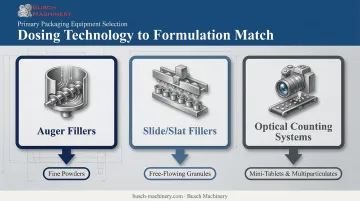
Mismatch the dosing technology to the formulation, and you'll fight fill-weight variance from day one.
That's why working with an experienced packaging machinery partner matters. Selecting, integrating, and validating VFFS and weighing equipment against cGMP requirements isn't a one-person job.
A single-source supplier reduces the tech transfer risk that appears when equipment from five different vendors has to work together on one line.
Conclusion
Stick packs deliver measurable advantages across dosing precision, patient compliance, cost efficiency, sustainability, and formulation flexibility. These benefits aren't theoretical: fill-weight logs, adherence data, and changeover schedules show the proof.
These gains compound over time, but only with the right machinery and process controls in place. Busch Machinery's VFFS and sachet filling systems, plus applications engineering support, provide that foundation. Stick pack adoption works best as an ongoing operational upgrade, one that pays off more the longer you run it right.
Frequently Asked Questions
What is a stick pack in pharmaceuticals?
A stick pack is a narrow, single-dose flexible pouch used to deliver precise amounts of powders, granules, mini-tablets, or liquids. It's produced on VFFS equipment and sealed to protect the dose until use.
What are the types of pharmaceutical packaging?
Primary pharma packaging formats include blister packs, bottles, sachets, stick packs, and vials. Each serves different dosage forms and patient compliance needs, from solid tablets to liquid unit doses.
What is a pharmaceutical blister pack?
A blister pack is a rigid, pre-formed cavity sealed with foil lidding, typically holding individual tablets or capsules. Unlike stick packs, blisters are built for solid dosage forms, not powders or liquids.
What is PVC in pharma?
PVC, or polyvinyl chloride, is a common rigid film used in blister packaging for its clarity and moldability. It's distinct from the flexible multi-layer laminates used in stick packs.
How much material can stick packs save compared to sachets or bottles?
Stick packs typically use less film than wider sachets or rigid bottles because their narrow, form-fitted shape reduces surface area per dose. Exact savings depend on your formulation and machine, but the material reduction is a consistent cost advantage.
What types of pharmaceutical products can be packaged in stick packs?
Stick packs suit powders, granules, multiparticulates, mini-tablets, and liquid formulations. This range makes them a fit for pediatric, geriatric, and general adult dosing needs across many therapeutic categories.