Introduction
You get a supplier quote back, and there it is: "turnkey package included." Sounds great. But what exactly does that cover?
Does it include installation? Training? Testing before the line ships? Or just the machines themselves, boxed and left at your loading dock?
This confusion isn't rare. Packaging machinery vendors use "turnkey" differently, and without a clear scope of work, buyers face hidden integration costs, installation delays, and finger-pointing when equipment doesn't perform as promised.
This guide breaks down what a turnkey package actually means in packaging machinery. You'll learn what it includes, how it differs from "full turnkey," see a real-world example, and get a checklist for evaluating any turnkey proposal before you sign.
Key Takeaways
- A turnkey package bundles equipment design, supply, installation, and training into one ready-to-operate solution
- "Full turnkey" often includes ongoing service, spare parts, or performance support, though usage varies by industry
- Genuine turnkey solutions include testing, validation, and compliance support—not just machine delivery
- Working with a single-source supplier reduces coordination risk and shortens the path to production
What Is a Turnkey Package?
"Turnkey" describes something built, supplied, or installed complete and ready to operate. Merriam-Webster traces the adjective back to 1860, and the meaning hasn't shifted much since: the buyer takes possession of something finished, not something they need to assemble.
The term's origin is literal. In a turnkey arrangement, the buyer simply turns a key to start operations instead of building the thing themselves. In legal and business use, a turnkey contract means the contractor holds full responsibility for planning and building the project, with the client using it immediately once it's complete.
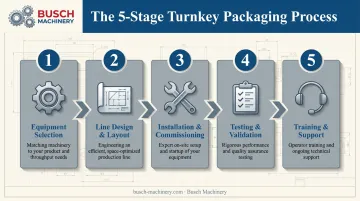
Applied to packaging machinery, a turnkey package means the supplier handles line design, equipment selection, integration, and commissioning. You don't hire a separate engineer to make everything work together. Production starts once the line lands on your floor.
Defining Characteristics of a Turnkey Arrangement
A genuine turnkey setup typically includes:
- One point of contact for the entire project, not five vendors pointing fingers at each other
- A defined scope and price, agreed before work begins
- Complete design accountability resting with the supplier, not split across departments
- Ready-to-run delivery, meaning the line works when it arrives, not after weeks of troubleshooting
Compare that to buying machines individually. You order a filler from one company, a capper from another, and a labeler from a third. Nobody owns the whole picture.
If the filler and capper don't talk to each other on the conveyor, you're stuck mediating between two vendors who each blame the other's equipment. That's the "weak link" risk of piecemeal purchasing: no single party accountable for the finished line's performance.
Turnkey vs. Full Turnkey: What's the Difference?
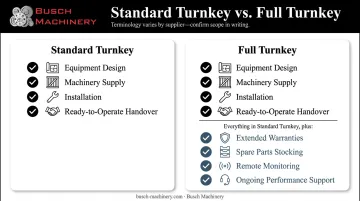
Here's something worth knowing before you get too attached to the terminology: "full turnkey" isn't a standardized industry category. No dictionary, trade association, or regulatory body defines it as a formal tier separate from "turnkey."
In practice, though, suppliers use the terms differently. Standard turnkey generally covers design, supply, and installation up through a ready-to-operate handover, while "full turnkey" (as some suppliers use it) often stretches further, adding extended warranties, spare parts stocking, remote monitoring, or ongoing performance support.
Because there's no universal definition, the label alone tells you very little. Ask any machinery supplier for a detailed scope-of-work document. That's the only way to know exactly where their turnkey coverage ends and where extra costs begin.
What Does a Turnkey Packaging Package Include?
A real turnkey packaging package goes well beyond dropping machines at your door. Here's what should be on the table.
Equipment Selection, Line Design, and Installation
The supplier matches machinery to your product, not the other way around. That means selecting fillers, cappers, labelers, bottling equipment, VFFS units, or multihead weighers based on:
- Fill volume and product viscosity
- Container type and material
- Required throughput
Line design and layout engineering follow, covering conveyor integration, facility footprint planning, and workflow sequencing so the equipment fits your existing plant, not a hypothetical one.
Once equipment is selected, installation and commissioning bring it into your existing plant systems, including PLCs, HMIs, and upstream or downstream machinery already on your floor. Before handover, the line should run through testing and validation, confirming speed, fill accuracy, and weight verification.
This matters even more in regulated industries. Food, pharmaceutical, and chemical manufacturers face documented equipment and validation requirements tied to their packaging lines. A supplier who understands this builds it into the process rather than treating it as an afterthought.
Training, Documentation, and Ongoing Support
Your team needs to run the equipment without calling the supplier every week. That means:
- Operator training on day-to-day use
- Manuals and maintenance schedules for upkeep
- Access to technical support after installation
Busch Machinery, for example, backs its turnkey packages with post-installation support and direct access to its team through a toll-free line and WhatsApp. That gives plant staff somewhere to turn once the line is running.
Example of a Turnkey Packaging Line in Action
Picture a beverage manufacturer launching a new bottled product. The supplier assesses the product's viscosity and the container's shape, then selects a filler sized to the fill volume, a capper matched to the closure type, and a labeler suited to the container's surface.
A check weigher and metal detector get integrated for quality control before the line ships. Everything arrives pre-tested and ready to run.
Packaging World's coverage of turnkey line integration describes this exact approach: the whole line gets tested together before delivery, rather than each machine being debugged separately on the customer's plant floor.
Compare that to sourcing five machines from five vendors. You'd be the one troubleshooting why the capper jams every third bottle because the timing doesn't match the filler's output. Single-source suppliers who offer multihead weighers, VFFS machines, and end-of-line automation under one roof, Busch Machinery among them, exist specifically to remove that burden from your team.
Benefits of a Turnkey Packaging Solution for Manufacturers
The advantages of going turnkey show up long before you flip the switch on a new line.
Single point of accountability. One supplier manages design, delivery, and support. If something underperforms, there's no ambiguity about who fixes it.
Packaging World's integration research notes this consolidation also cuts internal staff time spent coordinating multiple vendors and reduces the number of trips needed to get a line running.
Faster time-to-production. Because equipment arrives pre-integrated and pre-tested, on-site commissioning delays shrink considerably. You're not waiting weeks for machines to "learn" how to work together.
Lower compatibility risk. The supplier bears responsibility for the entire line's performance, not just one machine's specs on paper. That shifts risk away from your team.
Improved ROI through precision. Accurate fill and weight verification directly reduce product giveaway. Manufacturers using checkweighing and multihead weighing technology catch underfills and overfills before products leave the plant, protecting margins on every unit shipped.
Simplified compliance support. Food, pharmaceutical, and chemical products carry different but overlapping regulatory demands, from equipment calibration checks to labeling accuracy. Experienced turnkey suppliers build these considerations into equipment selection from the start, rather than leaving compliance as your problem to solve after installation.
Is a Turnkey Package Right for Your Facility?
Turnkey solutions make the most sense for manufacturers who are:
- Launching a new product line and need equipment matched to it from scratch
- Scaling production beyond what current machinery can handle
- Replacing outdated equipment without an in-house engineering team to manage integration
Before committing, walk through a few key considerations:
- Budget flexibility: what tradeoffs are acceptable between automation level and upfront cost?
- Facility space: does your floor plan accommodate the line layout being proposed?
- Product characteristics: do viscosity, container type, and fill range match the equipment you're considering?
- Automation level: how much manual handling are you trying to eliminate?
If you're unsure how these factors apply to your operation, consult an experienced single-source provider. Busch Machinery offers engineering consultation for any budget and tailors turnkey solutions across filling, labeling, capping, weighing, and end-of-line automation for chemical, pharmaceutical, cosmetic, food, and beverage manufacturers.
Frequently Asked Questions
What does a turnkey package include?
A turnkey packaging package typically covers equipment selection, installation, integration with existing systems, testing and validation, and operator training. The goal is a line ready to run without additional engineering work on your end.
What is an example of a turnkey package?
A complete bottling line, delivered pre-integrated and pre-tested, is a common example. The supplier selects and combines the filler, capper, labeler, and quality control equipment into one validated system before it ships.
What is the difference between turnkey and full turnkey?
Turnkey generally covers design through installation and handover. "Full turnkey," where suppliers use the term, often adds ongoing support, spare parts stocking, or performance guarantees, though this isn't a standardized definition across the industry.
How much does a turnkey packaging package cost?
Cost depends on equipment complexity, integration scope, and industry compliance needs. Because every line is different, requesting a custom quote from your supplier is the only reliable way to get accurate pricing.
How long does it take to implement a turnkey packaging line?
Timelines range from several weeks to a few months, depending on equipment complexity, customization requirements, and how ready your facility is for installation. Simpler lines move faster than highly customized, multi-machine systems.
Can a turnkey package be customized for my specific product?
Yes. Suppliers tailor turnkey designs around your specific product characteristics, container type, and throughput needs rather than offering one-size-fits-all configurations. This customization is what makes the line work for your operation immediately after installation.