Introduction
Sterile syringe filling is the aseptic transfer and precise dosing of a sterile liquid drug product into a syringe barrel under tightly controlled conditions to prevent microbial and particulate contamination, as required under FDA and USP <797>/<800> sterile compounding standards.
We wrote this explainer for pharmaceutical and biotech manufacturers, CDMOs, compounding pharmacies, and packaging engineers evaluating fill-finish operations. For these teams, sterility isn't a nice-to-have. A single contamination event can trigger a recall, harm patients, or shut down a production line for months.
"Syringe filling" gets used loosely in casual contexts—think home injections or dermal filler touch-ups. At an industrial level, it's a different animal entirely: validated equipment, aseptic technique, and quality controls that leave no room for guesswork.
This article breaks down what the process is, why regulators mandate it, how it works step by step, where it's applied, and what factors determine whether it succeeds or fails.
Key Takeaways
- Sterile filling delivers contamination-free doses through validated aseptic methods, not standard filling equipment
- Two methods dominate: top-down barrel filling (industry standard) and bottom-up tip filling (common in compounding)
- Success depends on equipment precision, ISO/Grade A cleanroom control, and container-closure integrity
- This process underpins vaccines, biologics, insulin, and GLP-1 injectable therapies
- Choosing the wrong pump, method, or partner risks contamination or compliance failure
What Is the Sterile Syringe Filling Process & Why It Matters
Sterile syringe filling is the precise dispensing of a sterile liquid drug product into a pre-sterilized syringe barrel under aseptic conditions, followed by stoppering to preserve that sterility until the moment of injection.
The goal is straightforward on paper: a consistent fill volume, zero microbial contamination, and an intact seal ready for labeling or clinical use.
How this differs from related processes:
- Vial filling uses a different container geometry and closure system (rubber stopper plus aluminum crimp seal), which changes handling and inspection requirements
- Manual syringe draw-up at home involves no aseptic validation, sterilizing filtration, or environmental monitoring, making it a patient-administered task rather than a regulated manufacturing process
- Cartridge filling for autoinjectors shares similar aseptic demands but uses a different closure system (rubber plunger and seal) built for pen-injector devices
Why It's Used in Pharmaceutical & Biotech Manufacturing
Regulators don't leave this to interpretation. The FDA places exposed sterile product and container-closure surfaces in an ISO 5 critical area, while EU GMP Annex 1 designates the filling zone, stopper handling, and open primary packaging as Grade A operations.
Both frameworks exist because open syringe barrels are among the highest-risk exposure points in the entire manufacturing chain.
The industry's demands go beyond regulatory checkboxes:
- Batch-to-batch consistency for high-value biologics where dosing variance affects therapeutic outcomes
- Tight fill-volume tolerances, particularly for narrow-therapeutic-index drugs
- Hygiene controls that prevent particulate and microbial ingress at every open-container step
What happens without these controls? In November 2023, Nurse Assist recalled multiple saline and sterile water syringe products, including 3, 5, and 10 mL formats, after the FDA flagged a lack of sterility assurance, warning of potential infection risk to patients.
These controls are a regulatory mandate tied directly to patient safety. That mandate carries more weight each year as the market expands rapidly. The global prefilled syringe market, valued at $8.65 billion in 2026, is projected to reach $14.53 billion by 2031, a 10.9% compound annual growth rate. More product volume moving through fill-finish lines means more pressure on manufacturers to get the process right the first time.
How the Sterile Syringe Filling Process Works (Conceptual Flow)
At a high level, the process runs from aseptic setup through final closure, with several inputs converging at once:
- Pre-sterilized, depyrogenated syringe barrels
- Filtered, degassed drug formulation
- Sterile stoppers and plungers
- HEPA-filtered cleanroom air supply
A pump, either peristaltic, rotary piston, or pneumatic, delivers a metered dose through the open barrel top (barrel filling) or through the luer tip (tip filling).
Flow rate, pressure, and fill time are all controlled and logged under validated GMP procedures, with environmental monitoring running continuously in the background. The end result: a syringe with a verified fill volume, minimal trapped air, and an intact seal ready for secondary packaging.
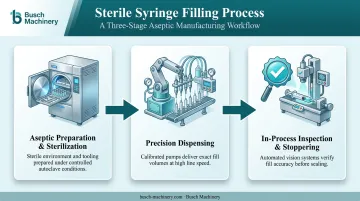
Here's how that plays out in three stages.
Step 1: Aseptic Preparation & Sterilization
Before any liquid touches a syringe, components go through validated cleaning, sterilization, and depyrogenation cycles. Dry-heat depyrogenation, for example, must demonstrate at least a 3-log endotoxin reduction to pass validation. In parallel, the drug formulation gets filtered, typically through a 0.2-micron or smaller sterilizing filter, and degassed if the product is oxygen-sensitive (a common concern with protein-based biologics). Stoppers and plungers typically undergo their own sterilization cycle, often autoclaving or gamma irradiation, before entering the fill line.
Step 2: Precision Dispensing
Pump type and fill-method selection both depend heavily on the product itself:
- Peristaltic pumps work well for shear-sensitive biologics, since only the tubing bore contacts the product, and can achieve metering accuracy within roughly 0.5% under proper conditions
- Rotary piston pumps suit more viscous formulations, offering high dosing accuracy across a broad range of products
- Barrel filling dispenses through the open rear of the barrel and remains the industry standard for accuracy and throughput
- Tip filling dispenses bottom-up through the luer tip, more common in lower-regulation compounding settings, and helps with viscous products or bubble minimization
Step 3: In-Process Inspection & Stoppering
Once the dose is dispensed, automated systems verify fill volume, often through 100% gravimetric weight checks with automatic micro-adjustments. Vision systems scan for bubbles, particulates, and cosmetic defects, then sterile stoppers get inserted under continued aseptic conditions. A final closure inspection confirms the seal before the unit moves downstream. Visual inspection alone isn't considered sufficient; container-closure integrity testing (per USP Chapter 1207) is required to catch failures that cosmetic checks miss.
Where the Process Is Applied & Key Factors That Affect It
Sterile syringe filling runs across several equipment types and facility configurations:
- Aseptic fill-finish lines using isolators or restricted access barrier systems (RABS)
- Tabletop syringe fillers for lower-volume operations
- Full CDMO production lines
- Compounding pharmacy stations for patient-specific preparations
It shows up at multiple points in a product's lifecycle: primary drug manufacturing, contract fill-finish services, and repackaging for clinical trials or commercial launch.
Key Factors That Affect the Process
Several variables determine whether a filling line performs reliably:
- Formulation properties: Drug viscosity and stability directly affect dosing accuracy and pump selection
- Barrel material: Glass offers an established compatibility profile but carries breakage and delamination risk; cyclic olefin polymer (COP) provides tighter dimensional tolerances and break resistance
- Cleanroom classification: Temperature, humidity, and pressure differentials all influence contamination risk in Grade A/ISO 5 zones
- Pump type: Peristaltic pumps suit shear-sensitive biologics; rotary piston systems handle viscous fluids better
- Throughput needs: Batch size and speed requirements determine whether manual, semi-automated, or fully automated systems make sense
Choosing equipment scaled for the wrong throughput either wastes capital or creates a bottleneck downstream. This is where partnering with an experienced packaging machinery supplier like Busch Machinery pays off.
With over 40 years matching equipment to product and volume requirements across pharmaceutical, food, and chemical manufacturing, Busch's applications engineering team helps facilities think through the full line. That includes downstream labeling systems like syringe-specific labelers built for handling unstable, cylindrical containers post-fill.
Beyond throughput and equipment selection, regulatory frameworks shape choices from day one. 21 CFR Part 211 and EU Annex 1 govern aseptic processing, container-closure integrity, and environmental monitoring requirements that any filling line must satisfy before a single unit ships.
Common Issues, Misconceptions & When the Process May Not Be Appropriate
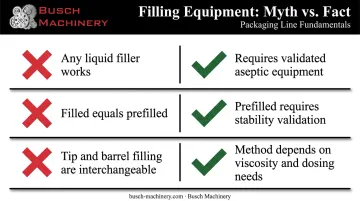
A few misconceptions cause real problems on the manufacturing floor.
"Any liquid filler can handle sterile syringes." Not true: sterile filling requires validated aseptic technique, qualified environmental controls, and equipment specifically designed to operate within a Grade A or ISO 5 zone. A general-purpose liquid filler, however precise, isn't automatically suitable without that validation layer.
"Filled" and "prefilled" mean the same thing. They don't: a filled syringe hasn't necessarily been validated for long-term drug stability or ready-to-use status. Prefilled syringe products go through additional stability testing and container-closure validation that a one-off fill doesn't require.
"Tip filling and barrel filling are interchangeable." Also false: product viscosity and regulatory requirements dictate which method fits, since thin solutions suit tip filling while viscous suspensions often need barrel filling for accurate dosing. Treating them as swappable ignores real differences in contamination risk and dosing accuracy.
Sterile syringe filling also isn't always the right call:
- Low-volume R&D batches where full validation overhead isn't justified
- Highly unstable formulations requiring immediate compounding at point of care
- Cases where unit-dose vials offer a more practical container format
Conclusion
Sterile syringe filling is a validated, multi-step aseptic process built to ensure safe, accurate, contamination-free injectable delivery. Every stage, from component sterilization to final stopper insertion, exists to protect patients and satisfy regulators who take container-closure integrity seriously.
Getting this process design right protects patients, satisfies regulatory requirements, and keeps production running efficiently. There's no shortcut around correct application. Facilities evaluating fill-finish operations benefit from partnering with an experienced packaging machinery provider such as Busch Machinery for equipment selection and engineering consultation. That partnership supports long-term quality and compliance, not just a one-time equipment purchase.
Frequently Asked Questions
What is aseptic filling of syringes?
Aseptic filling dispenses a sterile drug product into a syringe within a contamination-free environment using validated equipment and technique. This requires ISO 5 or Grade A air quality, sterilized components, and continuous environmental monitoring.
Can I prefill my tirzepatide syringes?
Prefilling compounded medications like tirzepatide requires proper sterile technique, stability validation, and adherence to pharmacy and regulatory guidelines. Consult a licensed pharmacist or physician before attempting this.
How much filler is in one syringe?
Fill volume varies by product and syringe size, typically 0.5 mL to 5 mL for pharmaceutical products and 0.8 mL to 1 mL for dermal fillers. Manufacturers specify exact volumes on the product label.
What's the difference between barrel filling and tip filling?
Barrel filling dispenses product through the open top of the syringe and is the industry standard for accuracy and throughput. Tip filling dispenses through the luer connection and is more common in compounding settings.
What equipment is used for sterile syringe filling?
Common equipment includes peristaltic and rotary piston pumps, isolators or RABS for environmental control, and automated inspection systems for fill verification, bubble detection, and cosmetic defect scanning.
Is sterile syringe filling done manually or by automated machines?
Both exist, but automated and semi-automated systems dominate commercial pharmaceutical production. They offer higher accuracy, throughput, and contamination control than manual methods can reliably deliver.