Introduction
Every tablet that reaches a pharmacy shelf or a supplement bottle has to survive packaging first. Tablet packing machines are the automated equipment that seals, protects, and prepares tablets and capsules for distribution across pharmaceutical, nutraceutical, food, and chemical manufacturing.
Choosing the wrong type carries real consequences. A Packaging Digest review of FDA notices found six pharmaceutical recalls in Q1 2025 alone tied to issues like contamination, mislabeling, and defective delivery systems—several of them packaging-related.
Product protection, dosage accuracy, regulatory compliance, and production speed all hinge on matching the machine to the product. This guide breaks down the main types of tablet packing machines, how they differ, and how to select the right one for your production line.
TL;DR
- Tablet packers span strip/blister, bottle counting, and pouch/VFFS formats.
- Machine choice hinges on tablet sensitivity, dosage format, and speed needs.
- Pharma leans on strip/blister packing; nutraceuticals and OTC favor bottle counters and pouch machines.
- Choose based on sensitivity, scale, regulations, and total cost — not price alone.
- A single-source supplier simplifies selection, integration, and long-term support.
Understanding Tablet Packing Machines
What Is a Tablet Packing Machine?
A tablet packing machine is automated equipment that measures, fills, seals, or counts tablets into a specific format — strip, blister, bottle, or pouch. It typically sits at the final stage of a solid-dosage production line, right after compression, coating, and inspection.
The machine you need depends entirely on where that tablet is headed next: a hospital pharmacy, a retail shelf, or a sample pack. A strip pack headed to a hospital may need moisture-resistant foil, while a bottle bound for a retail shelf calls for child-resistant caps and tamper bands.
Why Tablet Packing Machines Matter
The right equipment protects tablets from moisture, light, and contamination while ensuring accurate dose counts. It also supports compliance with cGMP requirements, tamper-evidence rules, and serialization mandates.
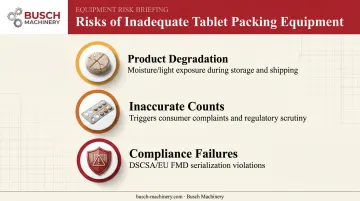
Without proper packing equipment, manufacturers risk:
- Product degradation from moisture or light exposure during storage and shipping
- Inaccurate counts that trigger consumer complaints or regulatory scrutiny
- Compliance failures under DSCSA (US) or EU FMD serialization requirements
One real-world example: Apotex Corp. issued a nationwide recall of its Drospirenone and Ethinyl Estradiol tablets in 28x3 blister packs after discovering blisters with missing or misarranged tablets. That single packaging error triggered a full nationwide recall.
Types of Tablet Packing Machines
No single machine fits every product. The right type depends on tablet sensitivity, packaging format, and production volume. Each category below balances protection level, dosage format, and throughput differently.
Strip Packing Machines
Strip packing machines seal tablets between two layers of heat-sealable film, such as aluminum foil, poly, or cellophane, forming a continuous connected strip. Unlike blister packing, this method uses flexible film-to-film sealing rather than rigid molded cavities.
Best suited for: High-volume generic and OTC tablets or capsules that need basic moisture and light protection without a premium finish.
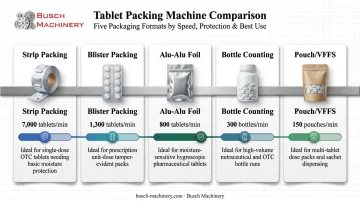
Strength: High-speed, low-cost-per-unit production, with published equipment maxima reaching up to 7,000 tablets per minute on some models. Limitation: Less rigid protection and a less premium shelf appearance compared to blister packs.
Blister Packing Machines
Blister machines thermoform PVC/PVDC or aluminum sheet into cavities, insert the tablet, then seal it with a foil backing. Rotary versions handle high-speed runs; flat-bed versions offer more flexibility for lower-volume production. The rigid-cavity design gives blister packs a tamper-evidence advantage that strip packs can't match.
Best suited for: Prescription medicines, unit-dose hospital packs, and branded retail products needing tamper-evident, child-resistant packaging.
Blisters also remain the dominant oral solid-dose format outside the US. A 2023 trade estimate puts blister packaging at roughly 85% of European oral solid-dose products, compared to about 20% of US prescriptions, where bottles still lead at 80% (Tablets & Capsules, 2023).
Strength: Strong dose visibility and tamper-evidence, with published outputs up to 1,300 blisters per minute on high-speed rotary models. Limitation: Higher machine and material costs, plus more complex changeovers between tablet sizes.
Aluminum Foil (Alu-Alu) Packing Machines
Alu-alu machines seal tablets between two aluminum foil layers instead of foil-and-plastic, creating a fully opaque, near-impermeable barrier. This eliminates the transparent plastic layer found in standard blister packs.
The barrier difference is measurable. A PQRI study testing water vapor transmission at 40°C/75% relative humidity found standard PVC blisters allowed 2.978–3.183 mg/cavity/day of moisture through, compared to near zero for cold-form aluminum foil (PQRI, 2010).
Best suited for: Hygroscopic or light-sensitive tablets, such as effervescent formulations, that need extended shelf life in humid climates.
Strength: Superior moisture and light barrier compared to standard PVC blister packaging. Limitation: No product visibility, higher material cost, and typically slower changeover between formats.
Tablet Counting & Bottle Filling Machines
These machines use electronic slat counters or vibratory feeders to count precise tablet quantities before filling bottles or containers. Unlike strip or blister machines, they package in bulk multi-dose containers rather than individual unit-dose pockets.
Best suited for: Nutraceuticals, vitamins, and OTC products sold in bottle format at retail or pharmacy.
Busch Machinery's own counting line illustrates the range available in this category:
| Model | Type | Speed | Best For |
|---|---|---|---|
| BMT-C4 | Semi-automatic tabletop | Up to 2,000 tablets/min | Check counting, small runs |
| Model 8S | 8-lane industrial | 10–40 bottles/min | Medium-scale production |
| Model 32S | 32-lane industrial | 20–120 bottles/min | High-volume bottling lines |
| BMT-C3 | Fully automatic | Up to 2,500 tablets/min | Unattended continuous operation |
Strength: Fast, accurate bulk filling, with some multi-lane systems counting thousands of tablets per minute. Limitation: Less unit-level tamper-evidence and dose control compared to blister packs.
Automatic Pouch & VFFS Packing Machines
Vertical form-fill-seal (VFFS) machines form pouches from roll film, fill measured tablet doses, and heat-seal in one continuous cycle. Instead of rigid containers, they produce flexible pouches or sachets.
Best suited for: Sample packs, multi-tablet unit doses, or products needing lightweight, flexible packaging, such as supplements or agricultural tablets.
Busch Machinery's VFFS line handles tablets and capsules alongside powders and granules. Sachet-specific configurations are sized for unit-dose formats (up to roughly 3⅜" wide by 4¾" long), with speeds in the 30–65 bags-per-minute range depending on the model.
Strength: Versatility across product types, with lower material costs than rigid formats. Limitation: Less rigid protection and shelf stability compared to blister or bottle packaging.
How to Choose the Right Tablet Packing Machine
The right choice depends on your product characteristics and business goals, not the machine's popularity or the lowest upfront price tag.
Product sensitivity and dosage format. Match barrier requirements (moisture and light protection) and dose type (unit-dose vs. bulk) to the right category. A hygroscopic effervescent tablet has nothing in common, packaging-wise, with a daily multivitamin.
Production scale and speed. Align machine output (packs, bottles, or pouches per minute) with your current volume and where you expect to be in two to three years. Overbuying capacity wastes capital; underbuying creates a bottleneck fast.
Regulatory and compliance needs. Confirm the machine supports tamper-evidence, serialization, and validation documentation for your target markets. Under DSCSA and EU FMD, identifiers generally attach to the saleable package level, not to every individual cavity, so define your saleable unit before specifying serialization hardware.
Budget versus total cost of ownership. Factor in:
- Machine purchase price
- Ongoing consumables (film, foil)
- Changeover parts and downtime
- Maintenance and technical support
A cheaper machine with expensive consumables or frequent changeover delays can cost more over five years than a pricier, more efficient alternative.
Partnering with an established single-source supplier removes much of the guesswork. Busch Machinery has spent over 40 years engineering packaging solutions across pharmaceutical, food, chemical, and nutraceutical manufacturing. The company works directly with customers to match production needs to the right equipment type, then supports it long after installation.
Common Mistakes to Avoid When Choosing a Machine
Even experienced buyers fall into predictable traps when selecting packing equipment. Watch for these three:
- Overbuying speed. Selecting a high-speed or highly advanced machine when current volumes don't justify the added cost or complexity. That extra throughput sits idle while you pay for it every month.
- Ignoring consumable costs. Film, foil, spare parts, and changeover downtime add up fast. Compare total cost of ownership, not just the machine's sticker price.
- Delaying compliance planning. Waiting until after purchase to address serialization or documentation requirements often forces costly retrofits or validation delays down the line.
Busch Machinery's engineering team can help you avoid these pitfalls early.
Conclusion
Tablet packing machines protect product integrity and enable compliant, efficient distribution. That's the whole job, whether the format is a foil strip or a serialized bottle.
Strip, blister, alu-alu, bottle-counting, and pouch/VFFS machines each solve a different combination of sensitivity, format, and volume needs. None of them is universally "better" — the right fit depends on your specific tablet and your production goals.
Partnering with an experienced packaging machinery supplier like Busch Machinery ensures you get equipment that actually fits, along with engineering support that lasts well past installation day.
Frequently Asked Questions
What is the packing method for tablets?
Manufacturers typically pack tablets using strip packing, blister packing, bottle filling/counting, or pouch (VFFS) methods. The choice depends on the protection level and dosage format the product needs.
What is a packing machine called?
Most manufacturers call it a "tablet packing machine" or "packaging machine," with specific names like blister packer, strip packer, or bottle filler depending on the format it produces.
What is the difference between strip packing and blister packing?
Strip packing seals tablets between flexible films for speed and lower cost. Blister packing uses rigid thermoformed cavities, offering stronger tamper-evidence and product protection.
Which tablet packing machine is best for small-scale or nutraceutical production?
Compact bottle-counting machines, like a semi-automatic tabletop counter, or flat-bed blister/pouch machines typically work best for lower-volume operations. They cost less and offer easier changeover between products.
How much does a tablet packing machine cost?
Costs vary widely based on automation level, speed, and machine type. Request a quote based on your specific production requirements rather than relying on general pricing estimates.
What industries use tablet packing machines besides pharmaceuticals?
Nutraceutical, cosmetic, food and beverage, chemical, and agricultural product manufacturers also use tablet packing machines for solid-dose products like vitamins, supplements, and specialty tablets.